
Birdeye is a broad reputation, reviews, and customer messaging platform used across many local-business industries, including dentistry. If you are looking for Birdeye alternatives, the first question is which job you are actually buying for. If you want reviews, listings, surveys, and reputation management across a group of locations, the close comparisons are Podium, Reputation.com, Solutionreach, and Weave. If your real gap is that patient inquiries go unanswered and appointments do not get booked, that is a different job, and a dental-specific AI front desk such as cOpilot from scanO is the closer fit. This page is for dental practice owners and office managers outside India who want a capability-first comparison.
Below: what Birdeye covers, the alternatives compared by capability, where cOpilot fits, and who should stay with Birdeye.
What does Birdeye do?
Birdeye is a customer experience platform built around reputation. Its core areas are review generation and monitoring across the major review sites, business listings management, two-way text and webchat messaging, surveys and feedback collection, referrals, and reporting on all of it. It serves many industries, and it is built to work for a multi-location business of almost any type, which is both its strength and its defining trade-off.
For a dental practice, Birdeye is strong at the reputation side of growth. Being found, looking credible, collecting reviews consistently, and keeping listings accurate are real contributors to new patient flow. What it is not built to be is a dentistry-specific front desk. It is a broad platform for many industries, so the dental particulars, what a first visit involves, what counts as urgent, how to reassure an anxious patient, and how to capture dental intake, are not where it concentrates.
Why practices look for alternatives
- They want the front desk answered, not the reputation managed. A steady flow of reviews brings people to your website. It does not answer them at eleven at night.
- They want fewer platforms, not more. Some practices find they are paying for breadth they do not use.
- They want dental depth. A tool that understands dentistry behaves differently from one built for a category that also includes auto dealers and home services.
- They want bookings as the outcome. Reviews and messages are inputs. A filled chair is the result being bought.
How do Birdeye alternatives compare by capability?
This table compares capability and model, not price. Pricing varies by vendor, module, location count, and region, and it changes, so contact each vendor for current plans. Feature sets move as well, so confirm anything decisive directly with the vendor. The capability read here comes from each vendor’s published materials in September 2026, and “Not documented” marks a capability we could not find described rather than one we know to be missing.
| Capability | Birdeye | cOpilot by scanO | Podium | Weave | NexHealth |
|---|---|---|---|---|---|
| Core model | Reputation and messaging | AI front desk for dentistry | Messaging and reviews | Phone-first comms suite | Scheduling and comms |
| Review generation and monitoring | Yes, a core strength | No | Yes | Yes | Partial |
| Business listings management | Yes | No | Partial | Partial | Not documented |
| Surveys and feedback | Yes | No | Partial | Partial | Partial |
| Two-way messaging | Yes | Yes | Yes | Yes | Yes |
| Website chat that converts visitors | Yes | Yes | Yes | Partial | Partial |
| AI answers patient questions 24/7 | Partial | Yes | Partial | Partial | Partial |
| Books appointments during the conversation | Partial | Yes | Partial | Yes | Yes |
| Collects structured dental intake | Not documented | Yes | Partial | Partial | Yes |
| Photo-based triage support | Not documented | Yes, on Pro plan | Not documented | Not documented | Not documented |
| Payments | Yes | No | Yes | Yes | Partial |
| Dental-specific by design | Multi-industry | Yes | Multi-industry | Dental and health | Dental and health |
The pattern in that table is breadth against depth. Birdeye and Podium are wide platforms that cover reputation, messaging, and payments across many industries. Weave and NexHealth are narrower and health-specific. cOpilot is narrower still: one job, one field, answering and booking dental patients. None of those positions is wrong. They answer different questions.
Are reputation and front desk the same purchase?
It is worth being blunt about this, because it is where budget gets spent on the wrong problem. Reputation work and front desk work sit at different points in the same funnel.
Reputation tools do top-of-funnel work. They make you findable and credible so that a person searching for a dentist ends up on your website with a good impression. That is genuine value, and Birdeye does it well.
Front desk tools do the next step. The visitor is already on your site, at ten at night, with a question. What happens in the next sixty seconds decides whether they book with you or go back to the results page. A reputation platform is not designed to carry that conversation to a booked appointment.
Practices that measure only reviews often cannot see this gap. The reviews go up, the traffic goes up, and the schedule does not, because the handoff between the two is where inquiries are lost. Look at how many inquiries arrive and how many become appointments before deciding which tool to buy. The broader mechanics are covered in a practical guide to dental front desk automation.
A reputation purchase solves
- Too few reviews, or reviews in the wrong places
- No process for asking at the right moment
- Listings that disagree with each other
A front desk purchase solves
- People who found you and still did not book
- Questions nobody is there to answer
- Interest that arrives outside opening hours
Where does cOpilot fit?
cOpilot comes out of scanO, a dental AI company, and it was designed for dental practices rather than adapted from a general local-business tool. It answers patient questions in plain language on your website and messaging channels, books appointments into your schedule, and collects dental intake, around the clock. Where Birdeye is broad, cOpilot is deliberately narrow: the questions it asks, the language it uses, and the intake it gathers are shaped for dentistry.
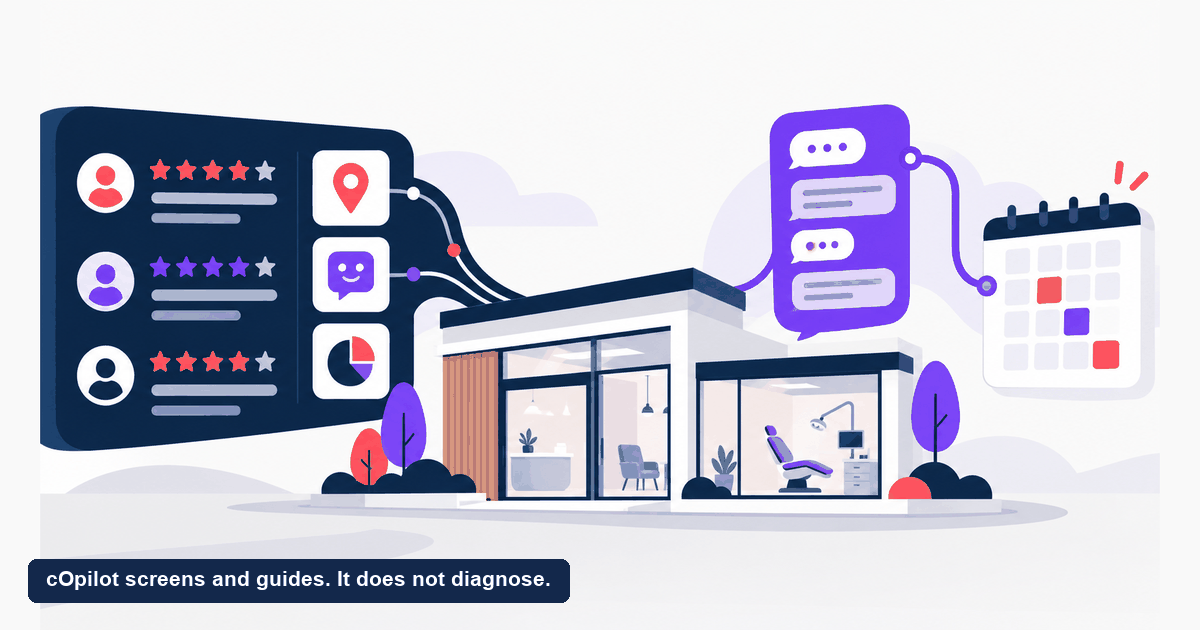
There is a further step on the Pro plan. When a patient attaches a photo to the chat, cOpilot flags what may warrant review and suggests an urgency level, which tells your team who needs a slot this week rather than next month. That is screening support for prioritizing, not a clinical conclusion. cOpilot screens and guides. It does not diagnose. Every clinical decision stays with the dentist, who is the only person qualified to make it. scanO’s platform is live in 1,066 dental clinics. For the product detail, see an AI receptionist that answers and books for dentists.
Be clear about what cOpilot does not do. It does not generate or manage reviews, it does not manage business listings, it does not run surveys, and it does not collect payments. If those are central to your plan, keep a platform that does them and add cOpilot for the conversation itself. Many practices end up with exactly that split, and it is a reasonable outcome rather than a compromise.
Who should stay with Birdeye?
Birdeye is a capable platform and leaving it is not automatically an improvement. Stay with Birdeye if:
- Reputation is your growth strategy. If reviews, listings, and search visibility are how you win new patients, that is Birdeye’s home ground and a focused front desk tool will not replace it.
- You run multiple locations and need consolidated reporting. Managing reputation across a group from one place is a real operational advantage, and specialist point tools rarely match it.
- You want reviews, messaging, surveys, and payments under one contract. Fewer vendors and one support line is a legitimate procurement position, even when it costs some depth.
- Your front desk is already covered. If inquiries are answered promptly and your book is full, adding a front desk layer solves a problem you do not have.
- You operate beyond dentistry. If your group includes non-dental businesses, a multi-industry platform is the sensible common denominator.
The switching decision comes down to one question: which number is your constraint? If it is reviews and visibility, keep the reputation platform. If it is inquiries that never turn into appointments, that is a different tool, and it is not the one you already have.
How do you choose between them?
Do this before you take any demos. Pull one month of inquiry data and split it three ways: how many people contacted you, how many got a reply within an hour, and how many ended up booked. Then note when the unanswered ones arrived. Practices that miss contacts during the working day have a staffing problem. Practices that miss them in the evening and at weekends have a coverage problem, and software fixes that far more cheaply than hiring.
Then ask every vendor the same questions. Does it book into my calendar, or only pass a message along. What happens when it does not know the answer. Where does patient data live, under which jurisdiction, and who can access it. How does it handle someone who says something urgent. What is included, and what is an add-on. Compare on capability first and price second, because capability comparisons age far more slowly. Pricing varies by vendor and market, so ask each one for current plans.
Frequently asked questions
What does Birdeye do?
Birdeye is a reputation and customer messaging platform. It covers review generation and monitoring, business listings management, two-way text and webchat messaging, surveys and feedback, referrals, and reporting, across many industries including dentistry.
What is the best Birdeye alternative for a dental practice?
It depends on the job. For a like-for-like reputation and messaging platform, Podium, Reputation.com, Solutionreach, and Weave are the close comparisons. If your gap is answering patient questions and booking appointments around the clock, a dental-specific AI front desk such as cOpilot is the better fit.
Is cOpilot a replacement for Birdeye?
Not a direct one. cOpilot does not generate reviews, manage listings, run surveys, or collect payments. It answers dental patients, books appointments, and collects intake. Practices that need both usually keep a reputation tool and add cOpilot for the front desk conversation.
Can I use Birdeye and cOpilot together?
Yes, and it is a common arrangement. Birdeye handles reviews, listings, and general messaging while cOpilot handles the dental-specific answering, booking, and intake on your website and after hours.
Does an AI front desk help with reviews?
Indirectly. Answering patients quickly and booking them without friction improves the experience people write about, but cOpilot does not run a review program itself. If review volume is your goal, use a tool built for that job.
How much does Birdeye cost?
Birdeye uses plan-based and quote-based pricing that varies by module, location count, and region, and it changes over time, so there is no dependable single figure to publish. Ask Birdeye for a current quote scoped to your practice and compare the full cost, including add-ons, against your chosen alternative. The same applies to every tool on this page.
Reputation work and conversion work solve different problems, and practices often buy the first when they needed the second. If your constraint is inquiries that never become appointments, read how a dental AI front desk answers and books, then have the scanO team walk you through the terms that apply in your market.