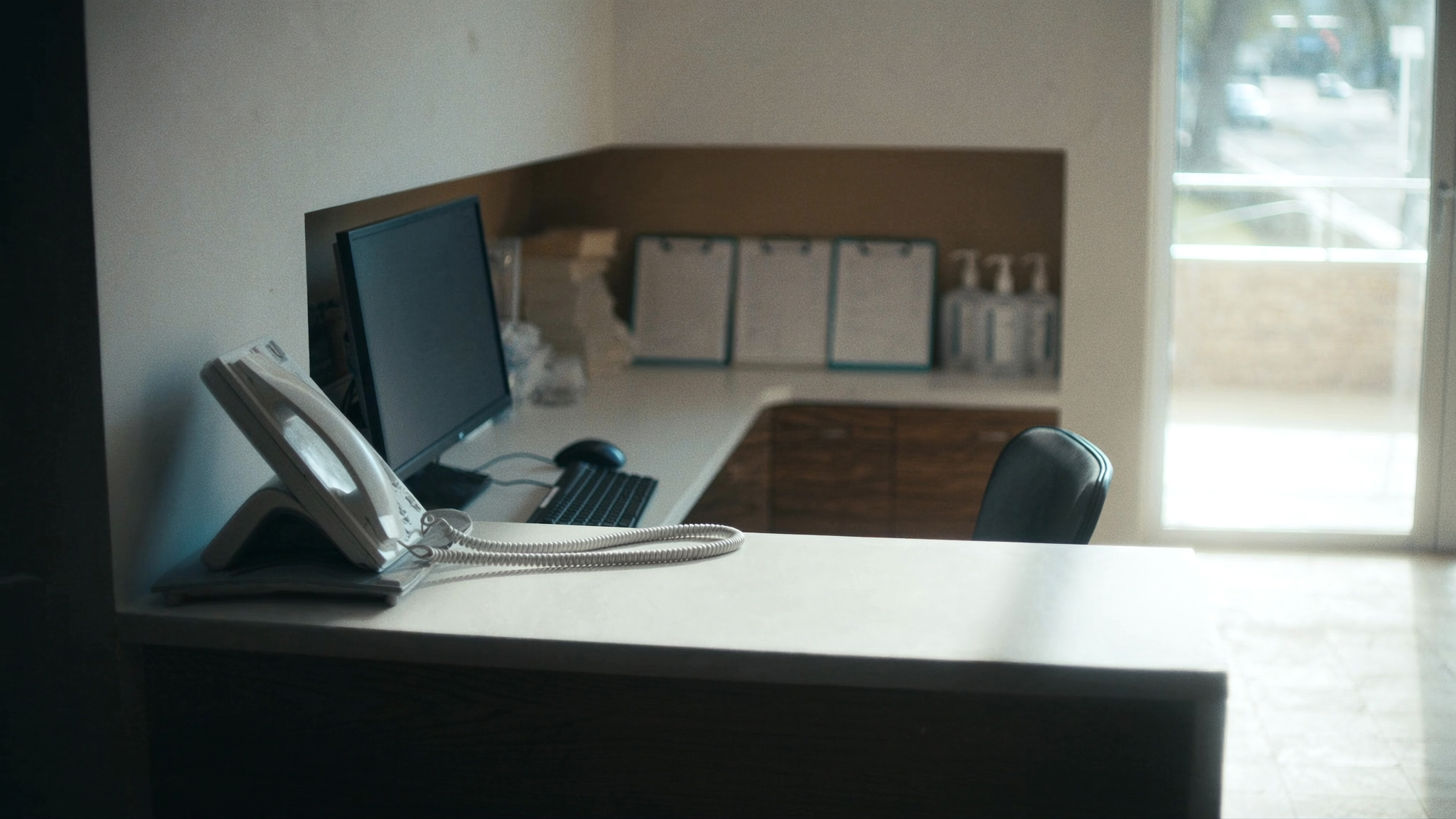
If you typed “ai receptionist for dentist” into Google after missing a few too many calls last week, you already know the problem. Patients text and call outside office hours, your front desk can only hold one conversation at a time, and every unanswered inquiry is a patient who might book with the practice down the street instead. This guide covers what an AI receptionist for dentists actually does, what it costs compared with a full-time hire or an answering service, and how to tell if it is worth it for your practice.
What Is an AI Receptionist for a Dental Practice?
An AI dental receptionist is software that answers chat and voice conversations on your website and phone line, day and night, using information specific to your clinic. It is not a generic chatbot that recites a canned script. A proper virtual dental receptionist reads your actual hours, services, insurance list, and policies, then holds a real conversation the way a trained front-desk hire would.
Three things separate a real AI front desk for dentists from a basic FAQ widget: it answers from your clinic’s own knowledge base, it books into your real calendar, and it knows when a conversation needs a human right away. A simpler, chat-only version of this is what most people mean by a dental AI chatbot, and an AI receptionist typically builds voice on top of that same foundation.
It answers from your clinic’s own knowledge base
Instead of guessing at generic dental FAQs, a well-built AI receptionist is trained on your website content, your hours, your accepted insurance, and your specific policies. Your team reviews and edits that knowledge base before it goes live, so the answers a patient gets match what your front desk would actually say.
It books directly into your calendar
This is the part that separates a receptionist from a chatbot. Instead of collecting a name and number for someone to call back tomorrow, the system checks real-time availability and confirms an appointment slot in the conversation itself, with no staff member touching the booking.
It knows when to escalate
A patient describing severe pain, facial swelling, or a knocked-out tooth should never be sitting in a chat queue. A properly designed system is built to recognize emergency language and route that patient straight to your phone line, rather than trying to “handle” a clinical situation it isn’t meant to touch.
What Does an AI Receptionist for Dentists Actually Cost?
Here is what the data actually shows for the three paths practices typically compare, real numbers instead of vague ROI talk.
The cost of a human front-desk hire
According to Indeed’s salary data, based on nearly 18,000 reported salaries, the average dental receptionist in the United States earns about $21.55 an hour. Glassdoor’s figures put the average annual base pay at roughly $46,428.
Base wage is only part of the real cost. The U.S. Small Business Administration notes that the fully loaded cost of an employee, once you add payroll taxes, benefits, and onboarding, typically runs 1.25 to 1.4 times their base salary. Applied to the figures above, a full-time front-desk hire realistically costs a practice $56,000 to $65,000 a year, before overtime, turnover, or training even enter the picture. And a human receptionist still can’t be at the desk at 9 pm on a Saturday.
The cost of a traditional answering service
If you have priced out a dental answering service alternative before, the range is wide. A 2026 pricing breakdown from Anytime TeleCare puts basic after-hours message-taking at about $25 to $100 a month, broader coverage handling a few hundred calls a month at $400 to $1,500 a month, and full 24/7 multi-provider plans at $1,000 to $3,000 or more.
The catch is what you get for that money. Most answering services take a message and pass it along. They generally can’t see your live schedule, confirm an appointment on the spot, or speak to your specific clinic policies or insurance list.
The cost of an AI receptionist subscription
Software pricing for a dental-specific AI receptionist is usually a flat monthly subscription, not a per-minute or per-call fee. As one example, scanO cOpilot runs $199 a month on the Plus plan or $299 a month on the Pro plan, which adds white-labeling and a HIPAA business associate agreement. That is roughly $2,388 to $3,588 a year, a fraction of a single front-desk salary, and it never needs a night shift.
AI Receptionist vs. Human Receptionist vs. Answering Service
None of these three fully replace the others, and being clear-eyed about that is more useful than picking a “winner.” Here is how they actually compare on the tasks a front desk handles every day.
- After-hours and weekend coverage: An AI receptionist covers this by design. A human receptionist doesn’t work nights. An answering service covers it, but usually only takes a message.
- Answering clinic-specific questions: A human knows the practice cold. A well-trained AI receptionist can match that for common questions. A generic answering service usually can’t, since agents are shared across many offices.
- Booking directly into your calendar: A human does this naturally. A modern AI receptionist can do it in the chat itself. Most answering services take a callback request instead.
- Emergency triage: A trained human recognizes urgency instantly. A good AI receptionist is built to detect emergency language and route the call. A basic answering service may just log it for the next business day.
- Hands-on tasks: Patient check-in, chairside comfort, collecting a copay. Only a human at the desk can do these, which is why an AI receptionist is meant to support your team, not replace the front desk.
Pros and Cons of an AI Receptionist for Your Practice
Weigh these honestly against how your practice actually runs before you decide.
The upside
The biggest one is coverage. Dental practices lose a real share of incoming calls to voicemail, hold times, and after-hours gaps. A 2026 Peerlogic study tracking 4,280 calls across 26 dental practices found that 38% of calls went unanswered during normal business hours, a share that climbs higher at peak times. An AI receptionist closes that gap without adding headcount, gives every visitor the same consistent, on-brand answer, and scales instantly when traffic spikes, with no scheduling or overtime involved.
The downside
An AI receptionist cannot check a patient in, hand them a form, or comfort someone anxious in the chair. Setting one up well takes a real review pass on the knowledge base so answers reflect your actual policies, not a generic template. Some patients will always prefer a human voice for anything emotionally loaded, like discussing cost or treatment fear. And it is not a diagnostic tool. It should never be positioned as anything more than a front-desk and triage aid that leaves clinical judgment to your dentists.
How to Decide If It’s Worth It for Your Practice
Run through this checklist honestly:
- Are patients contacting you outside your open hours, and do you have no way to respond until morning?
- Does your front desk get overwhelmed at predictable times, like lunch, Monday mornings, or right after a marketing push?
- Are you fielding the same handful of questions (hours, insurance, first-visit cost) over and over by phone or chat?
- Is your website bringing in traffic that isn’t converting into booked appointments?
- Would you rather add software than add another full-time hire right now?
If you answered yes to two or more, an AI receptionist is likely worth evaluating for your practice. If your real bottleneck is chairside capacity or provider availability, no front-desk tool, human or AI, will fix that on its own.
Where scanO cOpilot Fits In
scanO cOpilot is built specifically for dental practices, not adapted from a general-purpose customer service bot. It greets every website visitor instantly, answers from your clinic’s own reviewed knowledge base, and reads your real calendar availability to book and confirm appointments directly in the conversation, on chat or live voice. It also runs a brief in-chat oral-health check to understand what a patient needs before booking, and routes anything urgent (severe pain, swelling, trauma) straight to your phone line instead of trying to handle it in text.
Every conversation, scan result, and booking lands in a lead dashboard your team can see in scanO engage, so nothing gets lost between a chat and a chair. The platform is HIPAA-aligned, GDPR-compliant, and ABDM-aligned for practices in India, and patient data is never used to train AI models. Setup is one code snippet, no developer needed, live in under 10 minutes.
If you’re comparing several options, our AI front desk software buyer’s guide walks through the criteria worth checking before you commit, and our guide to dental front desk automation covers how these tools fit alongside the rest of your practice’s workflow.
Frequently Asked Questions
What is the difference between an AI receptionist and a dental AI chatbot?
A dental AI chatbot usually refers to the text conversation on your website. An AI receptionist describes the broader system, including voice, calendar booking, and emergency triage, that a chatbot can be one part of. In practice, vendors often use the terms interchangeably.
Can an AI receptionist actually book an appointment, or does it just take a message?
A basic answering service or an old-style chat widget takes a message. A modern AI receptionist, like scanO cOpilot, checks real-time calendar availability and confirms the appointment directly in the chat or call, with no staff member involved.
Is an AI receptionist for a dental practice HIPAA compliant?
It depends on the vendor. Look for explicit HIPAA alignment, a signed business associate agreement (BAA) if you’re in the United States, and a clear policy that patient data is never used to train the underlying models. scanO cOpilot is HIPAA-aligned, GDPR-compliant, and offers a BAA on its Pro plan.
How much does an AI receptionist for dentists cost compared to hiring staff?
Based on Indeed and Glassdoor wage data and the SBA’s fully loaded cost formula, a full-time front-desk hire runs roughly $56,000 to $65,000 a year. scanO cOpilot runs $199 to $299 a month, about $2,388 to $3,588 a year, covering hours a single employee physically cannot.
Will patients know they are talking to AI instead of a person?
A well-built AI receptionist should never pretend to be human. Patients generally care more about getting a fast, accurate answer and a confirmed appointment than about who, or what, is on the other end of the chat.
If your practice is losing patients to unanswered calls and after-hours silence, the fix does not have to mean hiring another full-time employee. Start a 14-day free trial of scanO cOpilot, no credit card required, and see your own AI receptionist for dentists live on your website in about 10 minutes.