
Most practices try to grow by driving more traffic. They pay for ads, tune their local listings, and chase reviews, all to get more people onto the website. Then the website quietly loses most of them. If you want more new dental patients, the cheapest win is rarely more visitors. It is converting the visitors you already have. A stranger who lands on your site at 9pm with one question about cost, insurance, or a chipped tooth is a real new-patient opportunity. If nobody answers in the moment, they tap back to search and book with the next clinic in the list.
This post is about closing that gap. Not more traffic, but more of your existing traffic turned into booked appointments. We will cover the tactics that actually move the number, and where an AI website front desk fits as the conversion step.
Why does your website lose new patients?
Your marketing does its job. It gets a motivated person to your site. The problem starts after they arrive.
Think about how people actually shop for a dentist. They compare two or three clinics in one sitting, usually on a phone, usually outside business hours. They are not filling out a long contact form and waiting a day for a callback. They want one question answered right now, and they want to know they can get an appointment.
A typical dental website asks them to do all the work:
- Read several pages to find whether you take their insurance.
- Hunt for a phone number, then call during hours they may be at work.
- Fill in a static form, then wait, with no idea when anyone will reply.
Every one of those steps is a place to lose them. Speed and ease are not nice-to-haves in dental patient acquisition. They are the whole game once the visitor is on the page.
None of this means your marketing is wrong. It means the last few feet of the journey, from interested visitor to booked patient, is where most of the money leaks out. Fixing that stretch is usually faster and cheaper than buying more clicks, because you are working with people who have already raised their hand.
How fast does the first response have to be?
The single biggest lever in converting dental website leads is response time. Interest is highest in the first few seconds a person is on your site. It cools fast after they leave.
An after-hours or lunchtime inquiry that gets a reply the next morning is usually a patient who has already booked somewhere else. The value was not in the callback. It was in the moment they asked.
So the goal is simple: answer common questions instantly, at any hour, in the visitor’s own words. Cost ranges, insurance and payment options, whether you see nervous patients, what to do about a broken tooth tonight. These are the questions that decide whether someone stays or leaves, and they rarely need a human to answer well.
This is exactly where cOpilot works. It greets every visitor 24/7 and answers their questions from your clinic’s own knowledge base, so a 9pm question gets a 9pm answer instead of a next-day voicemail.
Is booking the easy part or the hard part?
Once a visitor’s questions are answered, the next failure point is the booking itself. If booking means a phone call during office hours, you have handed the patient a chore and a delay. Many will not bother.
The fix is to let people book a new appointment in the same place they got their answer, in the same minute their intent is highest. No app to download, no account to create, no phone tag.
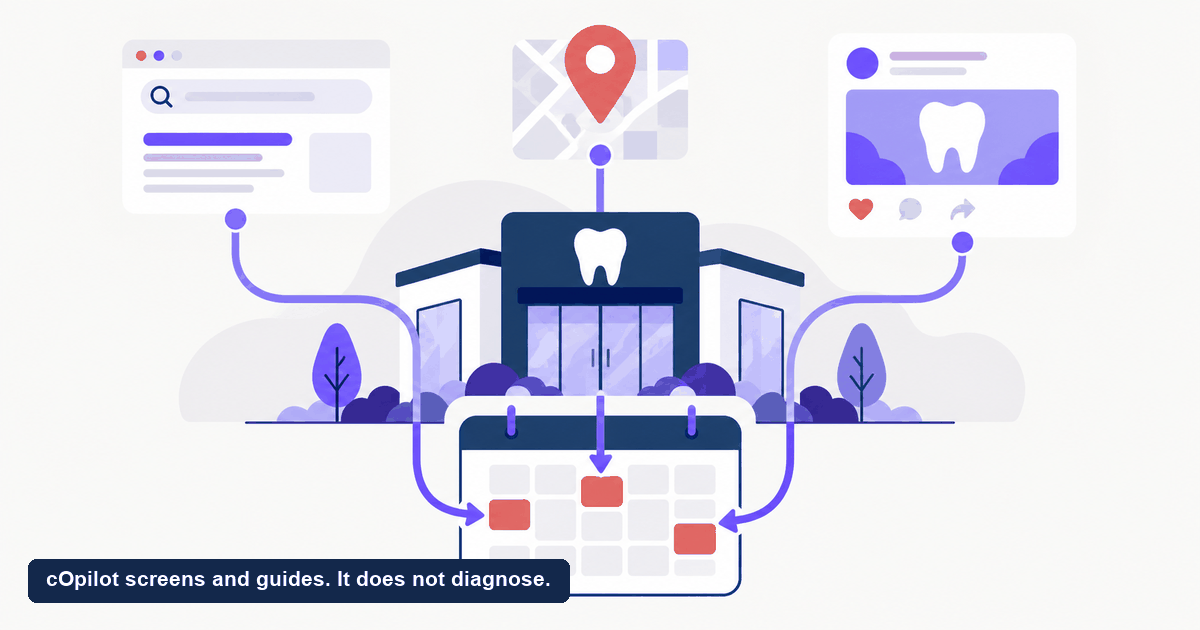
cOpilot books new appointments directly into your clinic calendar from inside the chat. A visitor can go from “do you take my insurance?” to a confirmed new-patient slot without leaving the conversation. For an emergency, it triages the case straight to your clinic phone line so a genuine urgency reaches a person quickly.
It is worth being clear about scope, because honesty builds trust. cOpilot books new appointments. It does not reschedule existing ones, send reminders, or run outbound texting. It works alongside the tools your front desk already uses, and it captures every chat, scan, and booking in the Engage lead dashboard so nothing that came through the website goes missing.
How do you cover the hours your team cannot?
A practice is open maybe 40 hours a week. Your website is open 168. Most new-patient searching happens in the gap: evenings, weekends, early mornings, and during the exact daytime stretches when your front desk is on the phone or turning over a room.
That gap is where growth hides. You are already paying to bring traffic to the site around the clock. If the site can only respond during business hours, you are funding demand you cannot catch.
Round-the-clock coverage does two things for you:
- It captures new dental patients who would otherwise leave when the office is closed.
- It relieves your front desk during the day, so the team handles patients in the chair while routine questions and simple bookings handle themselves.
You do not grow a dental practice by making your team work more hours. You grow it by making sure the website is never the reason a ready-to-book patient slips away.
There is a compounding effect here too. New patients booked after hours arrive with less effort from your team, which frees daytime capacity, which lets you take on more of the demand your marketing keeps sending. The website stops being a brochure and starts being the busiest, most patient member of your front desk.
How do you capture every enquiry?
Traffic you cannot measure is traffic you cannot improve. One of the quiet costs of a passive website is that the visitors who leave without calling are invisible. You never learn what they wanted or why they went elsewhere.
An interactive front desk changes that. Every conversation is a record: the question the person asked, whether they booked, and where they dropped off if they did not. That is real feedback on your dental patient acquisition, not a guess.
cOpilot logs each chat, each in-chat oral-health scan, and each booking in the Engage lead dashboard. The in-chat scan is an engagement and triage tool, a way to pull a curious visitor into a conversation. It is explicitly not a diagnosis and does not replace an in-person dental exam. Used honestly, it gives a hesitant visitor a reason to start talking, and it gives you a captured lead instead of an anonymous bounce.
Want to see how much this is worth for your practice? Put your own numbers into the missed-revenue calculator and see what unanswered website demand could be costing you each month.
What does a converting website look like?
The tactics stack. Fast answers keep the visitor on the page. Easy booking turns intent into an appointment. Round-the-clock coverage catches the demand your hours miss. Lead capture tells you what is working. None of them requires more traffic. They just stop wasting the traffic you buy.
A single AI website front desk can do the conversion work across all four. If you want the deeper background on how this role works, read our guide to an AI receptionist for dentists, or see the full picture on the cOpilot homepage.
cOpilot installs with one no-code snippet and goes live in under 10 minutes, so you can test it against your own website traffic without a project. It is HIPAA-aligned and GDPR-compliant, and patient data never trains the AI.
Ready to turn more of your website visitors into booked patients? Start your free trial and see it working on your own site, or book a demo to walk through it with our team first.
Traffic that arrives and is never followed up is not a traffic problem. Dental lead management covers what happens after the enquiry lands.
FAQ
How do I get more new dental patients from my existing website? Focus on conversion, not just traffic. Answer common questions instantly at any hour, let visitors book a new appointment in a single step, and capture every inquiry so none is lost. Most practices already have enough website visitors. They lose them to slow responses and clunky booking.
What is the fastest way to grow a dental practice online? The fastest lever is response time. A visitor’s interest is highest in the first few seconds on your site and fades once they leave. Answering their question in the moment, and offering a booking right there, converts far more of the traffic you already pay for than adding more ads on top of a passive site.
Why do dental website leads not convert into appointments? Usually because of friction and delay. If a visitor has to read multiple pages, call during office hours, or fill in a form and wait, many give up and book elsewhere. Removing those steps, with instant answers and immediate booking, recovers leads that would otherwise leak away.
Does cOpilot help with dental patient acquisition after hours? Yes. cOpilot greets and answers visitors 24/7 from your clinic’s knowledge base, books new appointments into your calendar at any hour, and triages emergencies to your phone line. It captures every chat, scan, and booking in the Engage dashboard so after-hours demand is not lost.
Can an AI front desk replace my reception team? No, and it should not. cOpilot handles routine questions and new-appointment booking so your team is free for patients in the chair. It works alongside your existing tools, books new appointments only, and does not reschedule existing ones or send reminders.