

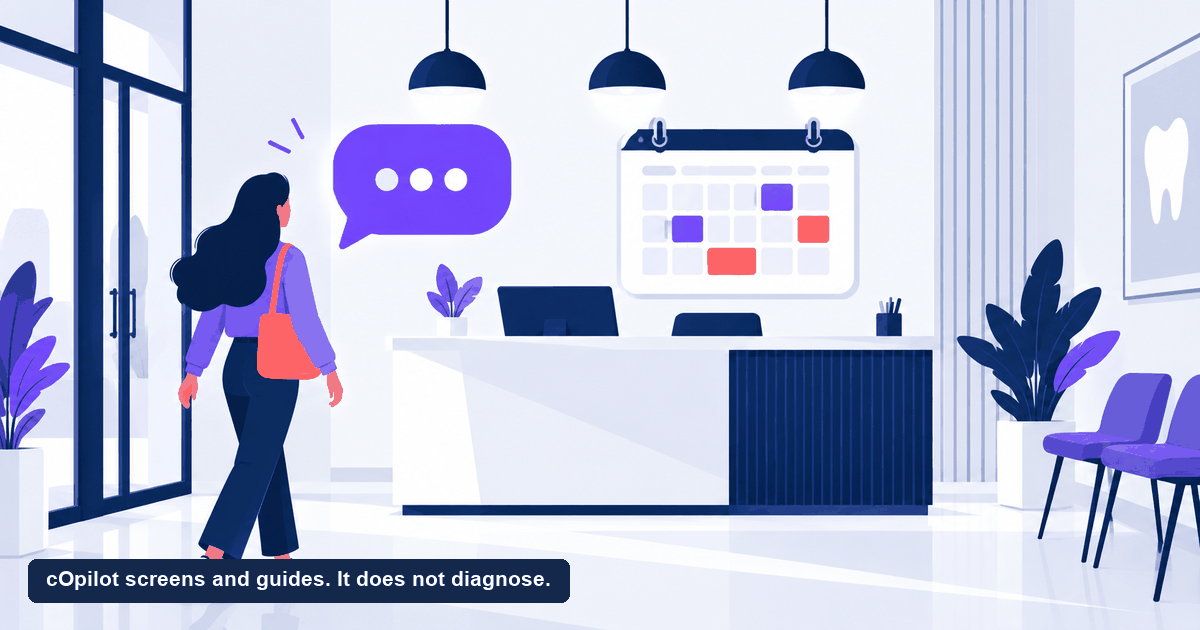
A patient decides how they feel about your practice in the first few seconds, long before they meet the dentist. The greeting at your front desk, on the phone, or on your website is the first impression, and it sets the tone for everything after. Learning how to greet a patient well is not a soft skill you can skip. It is the difference between a caller who books and a caller who hangs up, between a nervous new patient who relaxes and one who quietly cancels.
Most greetings fail in small, fixable ways. A rushed phone answer. A front desk buried in paperwork that does not look up. A website that meets an after-hours visitor with silence. This guide gives you five plain-language scripts you can use today, for the phone, in person, and online, plus the reasoning behind each one so your team can adapt them instead of reading them like robots.
Why does the first greeting shape everything after it?
A greeting does three jobs at once. It tells the patient they are in the right place, that a real person is paying attention, and that they are safe to ask for what they need. Get those three across in the first sentence and the rest of the visit runs smoother.
The stakes are highest for two groups: new patients who have never met you, and anxious patients who would rather be anywhere else. For both, the patient experience is decided before any clinical care happens. A warm, confident greeting lowers the guard. A cold or chaotic one confirms every fear they walked in with.
The reverse is also a revenue problem. A caller who reaches a flustered, distracted front desk often decides to try the next practice on their list. You never hear the objection. You just never see the patient. If you want a rough sense of how much after-hours interest slips away this way, the missed-revenue calculator gives a quick estimate.
What do strong greetings have in common?
Before the scripts, the pattern. Every good greeting, on any channel, includes four things:
- A warm opener that sounds like a person, not a recording.
- The practice name, so the patient knows they reached the right place.
- The patient’s name as soon as you have it, because nothing builds rapport faster.
- A clear next step, so the patient never wonders what happens now.
Keep it short. A greeting that runs three sentences long feels scripted. The goal is warmth plus direction in a single breath.
What should you say on the phone?
The phone is where most first impressions are won or lost, and it is the hardest to get right because your team is often mid-task. Answer within three rings, smile before you speak because it changes your tone, and use a consistent opener.
Script 1, the standard answer:
“Good morning, thank you for calling [Practice Name], this is [Name]. How can I help you today?”
For a new patient who sounds nervous, adapt it:
“I would be glad to help you get seen. Let’s find the soonest time that works for you. Can I start with your name?”
Two rules for the dental front desk on the phone. Never open with “please hold.” Acknowledge the caller first, then ask if they can hold for a moment. And always close the loop: repeat the appointment time back and tell them exactly what to bring.
What should you say in person?
The moment a patient walks in, look up and make eye contact before you say a word. A patient who stands unnoticed for even ten seconds already feels like an interruption.
Script 2, greeting a new patient:
“Hi, welcome to [Practice Name]. You must be [First Name], we have been expecting you. Let me get you settled.”
That phrase, “we have been expecting you,” does quiet, powerful work. It tells the patient they are known, not processed.
Script 3, greeting a returning patient:
“Hi [First Name], good to see you again. How have you been since last time?”
Using the name and referencing history turns a transaction into a relationship. If your notes flag something personal from the last visit, a small, sincere acknowledgment goes a long way.
What should you say to an anxious or upset patient?
Some patients arrive frightened, in pain, or frustrated about a bill or a wait. This is the highest-value greeting to get right, and the one most front desk scripts ignore.
Script 4, for an anxious or upset patient:
“I hear you, and I am really glad you came in. Let’s sort this out together. Tell me what is going on.”
The structure matters. Acknowledge the feeling, take ownership, then invite them to talk. Do not rush to defend the practice or explain policy. Slow your pace, lower your volume, and let the patient feel heard before you move to logistics. For a dental emergency, gather the clinical facts quickly and route the patient to the right person without making them repeat the story three times.
How do you greet patients online?
Here is the greeting most practices forget. A large share of patients meet you first on your website, often after hours, and a site that answers with a silent contact form greets them with nothing. The visitor with a throbbing tooth at 9pm does not wait until morning. They click to the next practice that answers.
Script 5, the greeting your website should give day and night:
“Hi, thanks for visiting [Practice Name]. I can answer your questions or help you book an appointment, any time. What brings you in today?”
This is the one part of greeting that software can genuinely own, and it is worth being precise about the boundary. cOpilot is an AI front desk for your website, not your lobby. It greets every visitor the moment they land, 24/7, answers their questions from your clinic’s own knowledge base, and books new appointments straight into your calendar, so an after-hours question becomes a booked patient instead of a lost one. Visitors can also share symptoms and run an in-chat oral-health scan, which is built for engagement and triage, is explicitly not a diagnosis, and does not replace an in-person exam.
What it does not do is greet the patient in your chair or answer your phone. Your team owns those moments, and the human scripts above are for them. cOpilot covers the online front desk so the greetings you have practiced are not undone by silence at midnight. You can see the full picture on the AI receptionist for dentists guide.
How do you make it a habit rather than a personality trait?
A good greeting cannot depend on who happens to be at the desk. Turn the scripts into a shared standard:
- Post the phone opener where every person who answers can see it.
- Role-play the anxious-patient script in a short team huddle until it feels natural.
- Agree on one rule everyone follows: look up and acknowledge within a few seconds, every time.
Consistency is what patients read as professionalism. When the greeting is the same warm, capable one on Tuesday morning and Friday afternoon, patients trust the whole practice more.
Want the online half of that greeting handled so no after-hours visitor meets silence? Start your free trial of cOpilot, or book a demo if you would rather see it live first.
FAQ
How do you greet a patient professionally? Lead with a warm opener that sounds human, say the practice name, use the patient’s name as soon as you have it, and give a clear next step. Keep it to a sentence or two so it feels sincere rather than scripted. The same pattern works on the phone, at the desk, and online.
What should a dental front desk say when answering the phone? Answer within three rings and use a consistent opener like, “Thank you for calling [Practice Name], this is [Name], how can I help you today?” Never open with “please hold.” Acknowledge the caller first, then ask if they can hold, and always repeat the appointment time back before you end the call.
How do you greet an anxious or upset patient? Acknowledge the feeling first, take ownership, then invite them to explain. Something like, “I hear you, and I am glad you came in. Let’s sort this out together.” Slow your pace, lower your volume, and let the patient feel heard before moving to scheduling or policy details.
Should a dental practice use scripts to greet patients? Yes, as a shared starting point rather than a rigid recording. Scripts keep the greeting consistent no matter who is at the desk, then your team adapts the wording to sound natural. Consistency is what patients experience as professionalism and trust.
Can cOpilot greet my patients? cOpilot greets visitors on your website only, 24/7. It answers questions from your knowledge base and books new appointments into your calendar. It does not answer your phone or greet patients in the office, and it does not send reminders or texts. Those moments stay with your front-desk team.