
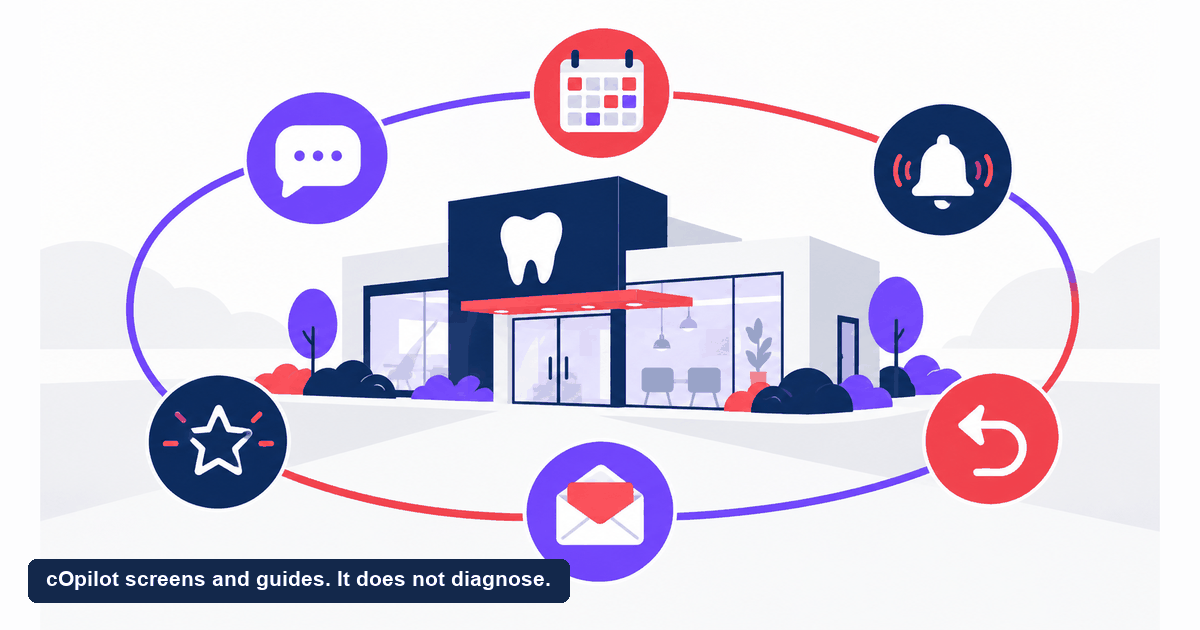
Dental patient communication is every exchange between a practice and a patient across the whole relationship, from the first inquiry to the review they leave afterward. Handled well, it comes down to six moments: answering the first question fast, making booking effortless, confirming and reminding before the visit, bringing people back on recall, reaching lapsed patients with a reason to return, and asking for feedback at the right time. Practices that get these six right usually fill more chairs than practices that simply advertise harder. This guide covers each moment, the channels patients actually respond to, and where to go deeper.
One idea runs through all of it. Patients are logical. They decide correctly when they are given clear information at the moment they need it. Most missed appointments and stalled treatment plans are not indifference. They are a communication gap.
What does dental patient communication actually cover?
It helps to see the lifecycle as a loop rather than a funnel. A patient does not arrive once. They arrive, return, lapse, and return again, and each stage has its own job to do.
| Stage | What the patient is asking | What good communication does |
|---|---|---|
| First inquiry | “Can you help me, and can I trust you?” | Answers immediately, in plain language, at any hour |
| Booking | “How soon can I be seen?” | Offers real times and confirms in a few taps |
| Pre-visit | “What do I need to bring or know?” | Confirms, reminds, and collects forms before arrival |
| In-chair and after | “What did you find, and what happens next?” | Explains clearly, then follows up in writing |
| Recall | “Am I due for anything?” | Reaches out before the patient has to remember |
| Reactivation | “Is it awkward to come back now?” | Makes returning easy and free of judgment |
| Feedback | “Was that worth telling people about?” | Asks at the moment of goodwill, and listens to complaints privately |
Most practices are strong at two or three of these stages and quietly weak at the rest. The weak ones are where patients leak out.
1. Why does speed beat polish on the first enquiry?
The first message a prospective patient sends is the highest-value communication your practice will handle that day, and it is usually the worst-served. It arrives through a website form, a social message, a call at lunchtime, or a query at nine in the evening. The practice that answers first, clearly, usually wins the booking.
Three things make a first response work:
- It is fast. Interest cools within minutes, not days. A person comparing three clinics is not waiting for tomorrow’s callback.
- It is specific. “We will get back to you” answers nothing. “We have Thursday at 4 or Friday morning, and yes we see anxious patients” answers everything.
- It is human in tone. Warm, plain, no jargon. People asking about their mouth are often embarrassed, and a formal reply makes that worse.
The awkward truth is that the questions that stall a booking are rarely the ones people phone to ask. Do you take my plan. Is it going to hurt. How much will a check-up run. Can I bring my child. If those go unanswered, the visitor closes the tab. This is why the first inquiry is really a website problem as much as a front desk problem, and why it is worth reading our guide to turning website visitors into booked patients alongside this one.
Where practices lose the first inquiry
- The phone rings out during clinical hours because the whole team is chairside.
- A web form lands in an inbox nobody checks until the next morning.
- An evening or weekend message sits unanswered until Monday.
- The reply is a callback request rather than an answer.
2. Which booking steps can you remove?
Once a patient decides, your only job is to get out of the way. Every extra step between decision and confirmed appointment costs you a share of the people who were ready.
A booking flow that works has four properties. It shows real availability rather than a request form. It works on a phone in a few taps. It confirms immediately, in writing, so the patient has proof. And it captures the information you actually need, not every field your software offers.
Be deliberate about what you ask for at this stage. Collect the minimum needed to hold the slot, then gather the rest through a secure intake step before the visit. Health details are sensitive by default, and a public booking form is the wrong place for a medical history.
3. Are reminders really the cheapest chair-filler?
No-shows are a communication problem wearing an operations costume. Patients rarely skip an appointment on purpose. They forget, they double-book, or life moves and they do not know how to tell you.
A reminder sequence that respects people looks roughly like this:
| When | Message | Why it works |
|---|---|---|
| At booking | Immediate confirmation with date, time, clinician and address | Gives the patient something to save and trust |
| A few days before | Reminder with a one-tap reschedule option | Turns a would-be no-show into a filled slot you can reuse |
| The day before | Short reminder plus anything to bring or complete | Removes the small frictions that cause late cancellations |
| Shortly after the visit | Aftercare notes and next steps in writing | Improves follow-through on what was agreed in the chair |
Two rules keep reminders from becoming noise. Always give a way to reschedule rather than only a way to confirm, because a patient who cannot easily move an appointment will simply not turn up. And keep clinical detail out of the reminder itself. “Your appointment with Dr. Okafor at 10:30” is fine. The reason for the visit is not something to put in a message that might be read on a shared screen.
4. Should recall rely on a system or a memory?
Recall is the quiet engine of a healthy practice, and it is almost entirely a communication discipline. The patient is not tracking their six-month interval. You are.
A recall system that holds up has three parts. A reliable list of who is due and when. A scheduled outreach that goes out without anyone remembering to send it. And a fallback for the people who do not respond the first time, on a different channel, a reasonable interval later.
The message matters less than the consistency, but tone still shifts results. Recall that reads as a reminder of care lands better than recall that reads as a sales prompt. “You are due for your check-up, here are two times that are free” beats “Book now to avoid problems.”
5. How do you reach patients you already earned?
Every practice has a list of people who came once or twice, meant to return, and never did. Some moved. Most did not. Reactivating them is the least expensive growth available to a clinic, because the trust was already built.
What stops people from returning is usually not price. It is a small, specific friction:
- Embarrassment about the gap since the last visit, or about what they think you will find.
- An unfinished treatment plan they never quite understood.
- A phone number they lost and a booking process they do not want to relearn.
- Nothing personal at all, only that nobody ever asked them to come back.
Reactivation outreach should name the friction and remove it. Acknowledge the gap without commenting on it, restate what was left pending in plain terms, and attach a way to book in one step. The dentist stays the hero of that message. Your software is only the envelope it arrives in.
6. When is the moment of goodwill?
Reviews are communication too, and they compound. A steady flow of recent, genuine reviews is what a stranger reads before deciding whether to inquire at all, which makes this stage the top of the next patient’s lifecycle.
Three principles keep review requests honest and effective. Ask soon after a good visit, while the feeling is fresh. Ask everyone consistently rather than cherry-picking, because selective asking is both unfair and detectable. And give unhappy patients a private route to you first, so a fixable problem is resolved rather than published.
Never offer anything in exchange for a review, and never write one on a patient’s behalf. Beyond the ethics, it is the fastest way to lose a profile that took years to build.
Which channels do patients actually use?
Channel preference is generational, situational and personal. The practical answer is to be competent on a few channels rather than present on all of them.
| Channel | Best for | Watch out for |
|---|---|---|
| Phone | Complex questions, anxious or older patients, urgent cases | Unanswered during clinical hours, which is when patients call |
| Text and messaging apps | Reminders, confirmations, quick back-and-forth, reactivation | Consent to message, and keeping clinical detail out of the thread |
| Website chat | First inquiries, after-hours questions, booking in the moment | A widget that only collects a name and promises a callback |
| Aftercare notes, forms, longer explanations, newsletters | Low open rates for anything time-sensitive | |
| Social messages | Younger patients, first contact, local visibility | Fragmented inboxes nobody owns |
Whatever the channel, one rule is constant across markets. Patient health information is sensitive by default. Keep clinical detail out of casual channels, obtain consent before messaging, and use tools that encrypt and control access to what they store. The obligations differ by region, and your own advisor should confirm what applies to you.

Who should do the communicating?
The honest constraint in most practices is staffing. The front desk is one or two people who are also greeting arrivals, handling payments, managing the schedule and calming a nervous patient in the waiting room. They cannot answer a website message at 9 p.m., and they should not have to.
This is where an always-on answer layer earns its place. A front desk assistant such as scanO cOpilot sits on the practice website, answers the routine questions that stall a booking, offers real appointment times, and passes the details to the team. It covers the hours nobody is at the desk and the moments when everyone is chairside. It answers and books. It does not diagnose, and it does not replace the clinical conversation that belongs to the dentist.
If you are weighing tools for this, start with our comparison of patient engagement software built for dental practices, and read the deeper explanation of an AI receptionist that answers and books around the clock. scanO works with 1,066 clinics across markets including the UK, the UAE, South Africa and India.
Better handled by a system
- Reminders, confirmations and recall
- First response outside opening hours
- Repeat questions with a settled answer
Better handled by a person
- Anything clinical or urgent
- Treatment and finance conversations
- A patient who is upset or hesitating
What should you measure?
You do not need a dashboard. You need five numbers reviewed once a month.
- Time to first response on inquiries, measured in minutes, not days.
- Share of inquiries that become booked appointments.
- No-show and late-cancellation rate, tracked before and after any reminder change.
- Recall attendance, the share of due patients who actually return.
- Reviews received per month, and how quickly you reply to them.
Measure in aggregate, never at the level of an individual patient’s details, and keep personal and health information out of analytics tools entirely. You can learn everything you need from patterns.
Where to go deeper
- Turning traffic into appointments: the website conversion playbook for dental practices.
- Choosing a platform: how dental patient engagement tools compare.
- Covering the hours you cannot staff: what an AI front desk does for a dental practice.
- Scheduling: dental appointment scheduling software.
- The wider picture: dental front desk automation.
- Before you choose any vendor: HIPAA and data protection for dental practices.
- Choosing a platform: how dental patient engagement tools compare.
- The system of record: choosing dental practice management software.
Communication works better when the history sits in one place. See what a dental CRM has to do for how practices keep that record straight.
Frequently asked questions
What is dental patient communication?
It is every exchange between a practice and a patient across the relationship: the first inquiry, booking, confirmations and reminders, aftercare, recall, reactivation and feedback. It covers the channel, the timing and the tone, not just the words.
How quickly should a dental practice respond to a new patient inquiry?
Within minutes wherever possible. People choosing a dentist compare options in real time, so the first clear answer usually wins the booking. If your team cannot respond that fast during clinical hours, an automated first response that offers real appointment times is the practical fix.
How do you reduce dental no-shows through better communication?
Confirm at booking, remind a few days ahead and again the day before, and always include a one-tap way to reschedule rather than only a way to confirm. A patient who can easily move an appointment will move it. A patient who cannot will simply not arrive.
What is the difference between recall and reactivation?
Recall reaches patients who are due for a routine visit on a known interval. Reactivation reaches patients who have lapsed and are overdue, often with unfinished treatment. Recall is a scheduled system. Reactivation is a campaign that has to remove the friction that stopped them from returning.
Which communication channel works best for dental patients?
There is no single best channel. Text and messaging apps work best for reminders and quick exchanges, website chat for first inquiries and after-hours questions, phone for complex or urgent conversations, and email for aftercare and forms. Be competent on a few rather than present on all of them.
Is it safe to send appointment details by text?
Appointment logistics are generally fine with consent. Clinical detail is not. Keep the reason for the visit, findings and treatment specifics out of casual channels, use tools that encrypt and control access to stored messages, and confirm what your market requires with your own compliance advisor, since rules differ by region.
The short version
Good dental patient communication is not a campaign. It is a loop that runs whether you tend it or not: answer fast, book easily, remind kindly, recall reliably, reactivate without judgment, and ask for feedback at the right moment. Close the weakest link first. The practice that is easiest to talk to is usually the one with the fullest schedule, and the dentist, not the software, is still the reason people stay.