

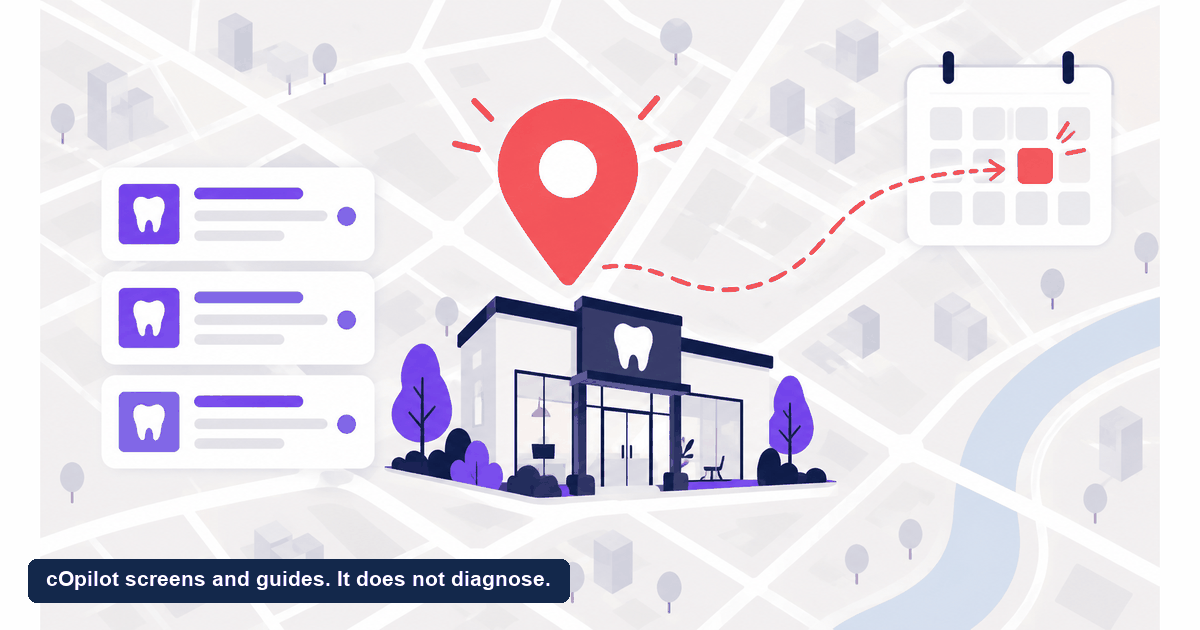
Local SEO for dentists is the work of making your practice the obvious choice when someone nearby searches for a dentist. It comes down to five things: a complete and active Google Business Profile, consistent name, address and phone details everywhere you appear online, a steady flow of genuine reviews, pages on your own site built for the places and services you actually serve, and the technical basics that let Google read all of it. Google itself says local results are ranked on relevance, distance and prominence. Source: Google, Improve your local ranking on Google. Everything below is how a dental practice moves the two it can control.
One caveat worth stating at the top, because it decides whether any of this pays. Local SEO buys you attention, not appointments. If the visitor lands on a site that cannot answer them or book them, you have paid for a click and lost a patient. The last section is about closing that gap.
How does Google decide which dentist to show?
Google describes three factors behind local results.
- Relevance. How well your profile and site match what was searched. This is why a profile that lists your services in plain language outperforms one that says “dental clinic” and stops.
- Distance. How far you are from the searcher or the place they named. You cannot change your address, but you can make your service area explicit.
- Prominence. How well known and well regarded you are, drawn from reviews, links, mentions and the rest of your web presence.
Source: Google, Improve your local ranking on Google. Distance is fixed. Relevance and prominence are the levers, and a practice that works on both steadily will outrank a bigger neighbor that does neither.
Signals you control directly
- Your Business Profile categories, hours and services
- Name, address and phone consistency across listings
- Location pages for places you genuinely serve
Signals you influence indirectly
- Review volume, recency and what they say
- Proximity of the searcher to your practice
- Links and mentions from local sources
1. Why is Google Business Profile the highest-return asset?
For most practices the profile drives more first contacts than the website does, because it sits at the top of the results with your hours, directions, reviews and a call button already visible. Treat it as a live property, not a one-time setup.
| Element | What good looks like |
|---|---|
| Primary category | The most accurate single category, with secondary categories for genuine specialties |
| Name | Your real practice name, with no added keywords or locations |
| Hours | Accurate, including holidays. Wrong hours generate complaints and poor reviews |
| Services | Every service listed individually, described in patient language |
| Photos | Real, current images of the exterior, reception, surgery and team |
| Q&A | Seeded with the questions you answer on the phone daily, and monitored |
| Booking and messaging | Enabled and actually monitored, because an ignored message costs you the patient |
| Posts | Occasional updates about services, availability or community work |
Two rules catch practices out. Do not stuff keywords into the business name, which violates the guidelines and risks the profile. And keep the exterior photo current, since patients use it to find your door.
2. Why does NAP consistency still matter?
NAP means name, address and phone number. Search engines cross-check yours across directories, health listings, insurance pages, social profiles and your own site. Contradictions weaken confidence in which details are correct.
Practices accumulate inconsistencies without noticing: a suite number that appears on some listings and not others, an old number from before a system change, an abbreviation used in one place and spelled out in another, or a duplicate listing created years ago by a previous manager.
- Write your canonical NAP once, exactly as it should appear everywhere, including punctuation.
- Search your practice name, your phone number and your address separately, and list every place you appear.
- Correct or claim each listing, starting with the ones that rank for your name.
- Find and remove duplicates, which are usually the biggest single source of confusion.
- Re-check twice a year, and immediately after any move, rebrand or number change.
Tedious, and it works. It is also the first thing to fix after a move, because stale addresses outrank the correct one for months if you let them.
3. How much do reviews actually move local rankings?
Reviews do double duty. They contribute to prominence, and they are the thing a prospective patient reads before deciding whether to contact you at all. A profile with recent, varied, specific reviews converts far better than one with a handful of old ones.
Build a routine rather than a campaign:
- Ask consistently. Everyone, after a good visit, through the same short message. Selective asking is unfair and detectable.
- Ask soon. Goodwill fades within a day or two.
- Make it one tap. A direct link, not an instruction to search for you.
- Reply to all of them. Briefly, warmly, and without ever confirming that someone is a patient or referencing their treatment. Privacy law applies to your review replies too.
- Give unhappy patients a private route first, so a fixable problem gets fixed rather than published.
Never offer anything in exchange for a review and never write one on a patient’s behalf. Beyond the ethics, incentivized reviews breach platform policies and can cost you the profile you spent years building.
4. Do you need a page for every location?
If you want to appear for a neighborhood, a town or a service in a place, you need a page that genuinely serves that search. The failure mode is obvious and common: the same page copied ten times with the place name swapped. That helps nobody and reads as thin content.
A local page earns its place when it carries information only a practice in that area would know.
| Page type | Use it when | Make it distinct with |
|---|---|---|
| Location page | You have more than one site | That site’s team, hours, parking, transit, accessibility, photos and its own map |
| Service page | Any treatment you want to be found for | Plain-language explanation, what the visit involves, aftercare, who it suits |
| Service plus area page | You genuinely draw patients from a nearby town or district | Local references, directions from that area, and the clinicians who see those patients |
One page per location, one per meaningful service, and a service-plus-area page only where the demand is real. Three strong pages beat thirty thin ones.
5. Which on-site basics does local SEO depend on?
None of this is exotic. It is a short list that most practice websites half-do.
- Title and description on every page, naming the service and the place, written for a human scanning results.
- One clear H1 per page that says what the page is.
- Mobile first. Most local searches happen on a phone, often while the person is out.
- Speed. A slow page loses visitors before any of your ranking work matters.
- Structured data for your practice, using the appropriate dental or medical business type, matching the details on your profile exactly.
- Internal links between related service and location pages, with descriptive anchor text.
- NAP in the footer sitewide, matching your canonical version character for character.
- An embedded map on the contact and location pages.
Two cautions specific to health sites. Keep patient information out of anything you publish, including reviews you quote, before-and-after imagery and testimonials, unless you hold written consent. And be careful what your analytics and tracking tools send to third parties from pages where patients describe symptoms, since health data carries obligations that ordinary website analytics does not anticipate.
6. What happens if visibility arrives and the site does not convert?
This is the part most local SEO advice skips. You can win the map pack and still not fill the schedule.
Think about when local searches happen. Someone with a sore tooth searches in the evening. A parent looks during a lunch break. A new arrival in town searches on a Sunday. Ranking first at 9 p.m. only helps if something answers at 9 p.m. Otherwise the searcher scrolls to the next practice, and the one that replied gets the patient you paid to attract. The operational answer to that is a dental front desk that never closes, which is a different project from ranking work and usually a faster one.
So pair the visibility work with three conversion checks:
- Can a visitor book without speaking to anyone? Real times, a few taps, on a phone. If you do not offer self-service online appointment booking yet, that is the highest-return fix on this page.
- Can a visitor get a quick question answered instantly, at any hour? The questions that stall a booking are rarely the ones people phone to ask.
- Is it obvious within seconds who you are, where you are, and why to trust you?
That last-mile problem is why practices add an always-on front desk layer. A website assistant such as scanO cOpilot answers the routine questions, offers real appointment times and passes the details to your team, covering the evenings and the hours when everyone is chairside. It answers and books. It does not diagnose, and clinical questions go to the dentist where they belong. The full treatment is in our guide to turn the traffic you earn into booked patients, and the specifics of the tooling are in an AI receptionist that picks up the after-hours searches.
What should you measure?
| Signal | What it tells you |
|---|---|
| Profile calls, direction requests and website clicks | Whether your listing is actually producing contacts |
| Rankings for your core service plus place terms | Whether relevance work is landing |
| New reviews per month and average rating | Whether the review routine is running |
| Organic sessions to service and location pages | Whether those pages earn their keep |
| Share of visitors who book | Whether visibility is turning into patients |
| Bookings and inquiries outside office hours | Whether you are catching evening searchers or losing them |
Review these monthly, in aggregate, and keep patient-identifying information out of analytics entirely.
What order should you do this in?
- Claim and complete the Google Business Profile, including services and photos.
- Fix NAP everywhere and remove duplicate listings.
- Start the review routine and reply to every existing review.
- Write or rewrite your top three service pages and each location page.
- Fix mobile speed, titles, H1s and structured data.
- Close the conversion gap: easy booking and an answer available after hours.
- Then, and only then, chase links and mentions from local organizations.
Frequently asked questions
How long does local SEO take for a dental practice?
Profile improvements can shift visibility within weeks. Review volume, content and prominence build over months. Treat it as a routine rather than a project, and expect the first meaningful movement from profile completeness and review flow, which are also the fastest things to fix.
Is Google Business Profile more important than my website?
For first contact, often yes, because the profile appears above results with your hours, reviews and a call button. The website still decides whether that contact becomes a booking, so the two work as a pair rather than a choice.
How many reviews does a dental practice need?
There is no threshold figure, and anyone quoting one is guessing. What consistently matters is recency, volume relative to nearby practices, specificity, and whether you reply. A steady trickle beats a burst followed by silence.
Should I create a page for every nearby town?
Only where you genuinely serve and draw patients from that area, and only if you can write something specific to it. Duplicated pages with the place name swapped are thin content and tend to underperform a single strong page.
Can I reply to a review that mentions treatment?
Reply, but do not confirm that the person is a patient or discuss any treatment detail. Thank them, offer to continue privately, and move the conversation offline. Patient privacy obligations apply to public replies, and this is a common and avoidable mistake.
Does local SEO work if my website cannot take bookings?
Partially, and expensively. You will earn calls during office hours and lose most evening and weekend interest. Adding self-service booking and an after-hours answer usually raises returns more than further ranking work.
The short version
Get the profile complete and active, make your details consistent everywhere, build a steady review routine, write pages that genuinely serve the places and services you cover, and keep the technical basics clean. Then make sure the visitor who arrives at 9 p.m. can get an answer and a booked appointment. Visibility you cannot convert is just traffic, and the practice that answers first is usually the one the patient chooses.