

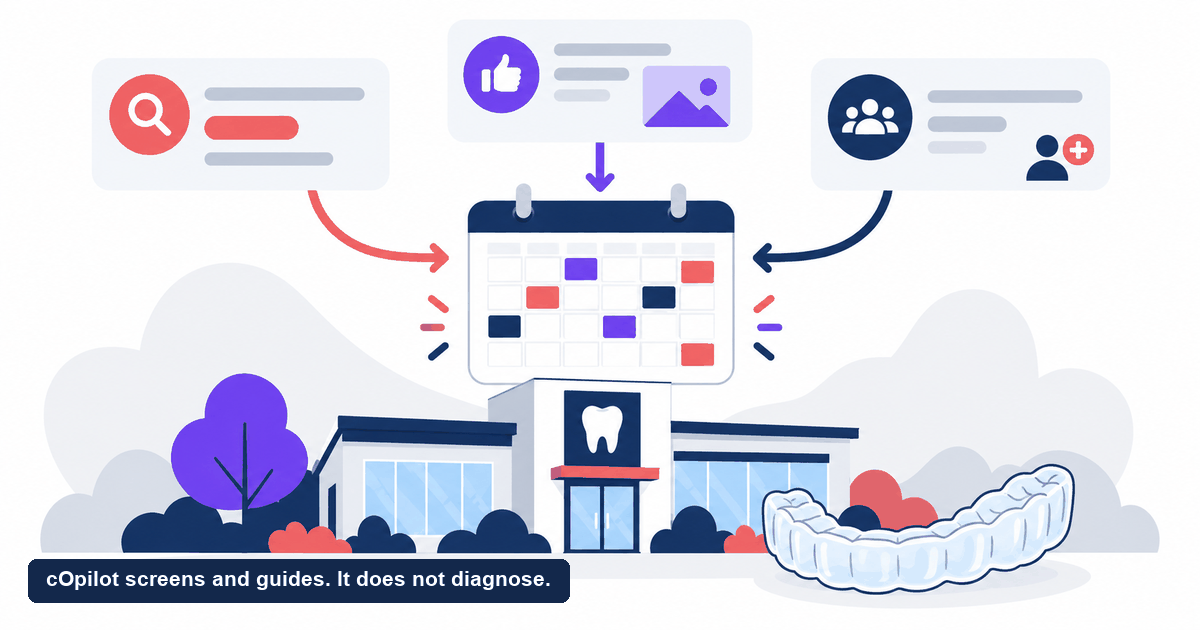
A parent searches “braces near me” at 9pm, lands on your site, reads two pages, and leaves without booking. A former patient recommends you to a friend, but the friend never gets around to calling. A polished ad campaign sends 200 clicks to a homepage that gives them nowhere obvious to start. Each of those is demand you paid to create and then lost. The best orthodontic marketing strategies are not just about creating more of that demand. They are about capturing more of the demand you already have. This guide covers the strategies that actually fill a schedule: local search, referrals, social proof, and the website conversion step where most orthodontic marketing quietly leaks.
What makes orthodontic marketing different?
Orthodontic marketing is not the same game as general dental marketing. The decision is bigger, slower, and more emotional. A patient choosing Invisalign or braces is often weighing a multi-thousand-dollar commitment over 12 to 24 months, and in many cases a parent is deciding on behalf of a teen.
That changes the math in a few ways:
- The buying cycle is longer. People research for weeks before they book a consult. Your marketing has to stay visible and reassuring across that whole window, not just win a single click.
- Trust does the heavy lifting. Before-and-after results, reviews, and word of mouth carry more weight than a clever slogan.
- The consult is the conversion, not the sale. Your immediate goal is a booked consultation, not a closed case. Every strategy below should be judged by how many new consults it produces.
Keep that last point in mind. It is easy to pour a budget into awareness and forget that a booked consult is the metric that pays the bills.
How do you win local search?
Most orthodontic demand starts with a local search. “Orthodontist near me,” “Invisalign [city],” and “braces for kids” are how parents and adults begin, and ranking for them is one of the highest-return orthodontic marketing strategies available.
The fundamentals are unglamorous but they work:
- Claim and optimize your Google Business Profile. Accurate hours, services, photos of your office and team, and a steady flow of recent reviews. This is often the first thing a searcher sees.
- Build location and service pages. A page for each core service and each area you serve helps you show up for specific searches instead of competing only on your homepage.
- Earn reviews consistently. Volume and recency both matter for local ranking and for the trust a searcher feels before clicking.
- Get listed accurately everywhere. Consistent name, address, and phone across directories reinforces that you are a real, established local practice.
Local SEO compounds. It is slower than paid ads to start, but the visits it produces do not stop the moment you pause spending.
How do you turn patients into referrals?
Referrals are the cheapest patient acquisition channel an orthodontic practice has, and orthodontics is unusually good at generating them. A visible result on someone’s teeth is a walking advertisement for months.
Make referrals a system, not an accident:
- Ask at the right moment. The end of treatment, when a patient is thrilled with their new smile, is the natural time to invite a referral or a review.
- Make sharing easy. A simple link, a card, or a quick request beats hoping people remember your name.
- Show your results. Before-and-after galleries, with proper patient consent, are the most persuasive content an orthodontic practice can publish.
Social media sits alongside referrals here. For orthodontics it works less as a hard-sell channel and more as ongoing social proof. Consistent posts of results, team culture, and patient stories keep you top of mind through that long research window. The goal of a post is rarely an instant booking. It is to be the practice a parent already trusts when they finally search.
Does your website convert or only attract?
Here is where most dental marketing budgets leak. Practices spend heavily to drive traffic through SEO, ads, and social, then send that traffic to a website that asks visitors to fill out a static form or call during office hours. A large share of that hard-won interest arrives after hours, on a phone, ready to ask one question, and finds no one home.
Conversion is the step that turns marketing spend into booked consults. A few principles:
- Answer the question fast. Adults want to know about cost, timelines, and Invisalign versus braces. Teens’ parents want to know about payment plans and first steps. If those answers are buried, people leave.
- Make booking obvious and immediate. The path from “I am interested” to “I have a consult on the calendar” should take seconds, not a callback the next business day.
- Meet after-hours interest. Evenings and weekends are when busy parents research. If your site cannot respond then, a competitor’s will.
- Reduce the number of steps. Every extra field or click is a chance to lose someone who was ready to book.
You do not need more traffic to grow if you are already converting only a fraction of the traffic you have. Fixing the conversion step is often the fastest win in the whole funnel. If you want to size that gap, our missed revenue calculator estimates what unanswered inquiries and missed bookings are costing you each month.
Which numbers should you track?
Marketing that is not measured tends to drift toward whatever feels busy. To keep your orthodontic marketing strategies honest, track a short list of numbers tied to patient acquisition:
- Cost per consult. What you spend to produce one booked consultation, by channel. This tells you where to put the next dollar.
- Website conversion rate. The share of visitors who actually book. Small improvements here multiply every other channel.
- Referral volume. How many new patients name another patient as their source.
- Consult-to-start rate. How many consults become active cases, which tells you whether you are attracting the right patients.
These illustrative metrics are examples of what to watch, not benchmarks to hit. Your own numbers over a few months are the ones that matter. The pattern most practices find is the same: they are better at creating demand than at capturing it, and the cheapest growth is plugging the leak between the two.
Where does cOpilot fit?
cOpilot by scanO is not your whole marketing stack. It does not do your SEO, run your ads, manage your reviews, or post to social. Those are the strategies above, and they belong to your team and the tools you already use. cOpilot handles one specific step: turning the website traffic your marketing creates into booked consults.
Here is the honest scope:
- It greets every website visitor 24/7 and answers their questions from your practice’s own knowledge base, so after-hours interest gets a real reply instead of a voicemail.
- It books new consultations directly into your calendar and triages urgent issues to your phone line.
- It offers an optional in-chat oral-health scan for engagement and triage. The scan is not a diagnosis and does not replace an in-person exam, but it gives a hesitant visitor a reason to start a conversation.
- It captures every chat, scan, and new booking in the Engage lead dashboard, so the demand your marketing worked to create is recorded cleanly instead of lost.
That is the conversion layer, and nothing more. For the wider picture of how a website front desk fits a practice, see our AI receptionist for dentists guide. Setup is no-code: drop in one snippet and you can be live in under 10 minutes, with a free trial you can extend to 30 days, and data handling that is HIPAA-aligned and GDPR-compliant.
If your marketing is already driving traffic that is not turning into consults, that is the exact gap to close first. Start your free trial and see how many bookings your existing traffic can produce. Prefer to see it in context of your funnel first? Book a demo.
FAQ
What are the most effective orthodontic marketing strategies? The highest-return strategies combine local SEO, a steady flow of reviews, a referral system, social proof through before-and-after content, and a website built to convert. Awareness channels create demand, but the conversion step, where interest becomes a booked consult, is where most practices see the fastest gains. Judge each strategy by how many new consults it produces, not by clicks or impressions.
How is orthodontic marketing different from general dental marketing? The decision is larger and slower. Patients weigh a multi-thousand-dollar, one to two year commitment, and a parent is often deciding for a teen. That means trust signals like reviews and visible results matter more, the research window is longer, and your immediate goal is a booked consultation rather than an instant sale.
How much should an orthodontic practice spend on marketing? There is no universal number, and this is a business decision to make with your own financials. A more useful approach than a fixed percentage is to track cost per consult by channel and shift budget toward what produces booked consults most efficiently. Improving your website conversion rate often lowers overall acquisition cost without any extra spend.
How do I get more orthodontic patients from my website? Answer common questions about cost, timelines, and treatment options quickly, make booking a consult take seconds, and make sure someone or something responds to after-hours and weekend interest when parents actually research. Reducing steps in the booking path and meeting off-hours demand are usually the two changes that lift website conversion the most.
Does cOpilot handle all of my orthodontic marketing? No. cOpilot does not run SEO, ads, social, or review management. It handles the conversion step: greeting website visitors, answering their questions, and booking new consults into your calendar, then capturing that activity in the Engage lead dashboard. It works alongside the marketing strategies and tools you already use.