

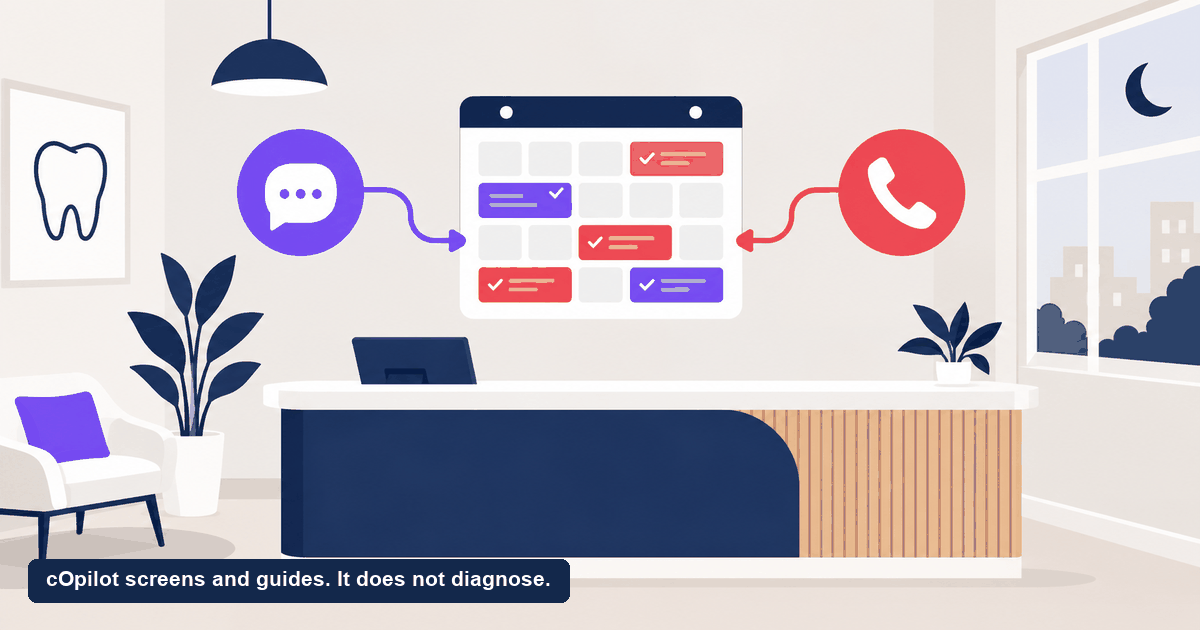
A dental virtual receptionist is an off-site service or software layer that answers your practice’s incoming calls, chats, and messages, books appointments, and captures patient details, so the phone is covered when your front desk cannot pick up. There are two models. A human answering service staffs trained agents who take calls on your behalf. An AI front desk answers in text and voice automatically, around the clock, at whatever volume arrives. Most practices outside India choose one, some run both. The right answer depends on how many calls you miss, when you miss them, and how much of the conversation needs judgment.
Below: what a dental virtual receptionist actually does, an honest capability comparison of the two models, where cOpilot from scanO fits, and who should choose a human service instead.
What is a dental virtual receptionist?
The term covers any arrangement where someone or something other than your in-house front desk handles patient contact. In dentistry that usually means four jobs: answering new patient inquiries, booking and rescheduling appointments, collecting intake before the visit, and handling routine questions about hours, location, and what a first visit involves.
The problem it solves is well understood by anyone who has run a practice. Your front desk is busy checking in the patient standing in front of them. The phone rings anyway. A caller who reaches voicemail on a Saturday afternoon does not usually leave a message and wait. They call the next practice on the list. Every unanswered inquiry is a patient who was ready to book and is now someone else’s patient.
The two models
Human answering services employ agents, sometimes dental-trained, who answer as your practice. They follow a script you supply, take messages, and in many cases book directly into your calendar. You pay for coverage, usually by call volume or by minute. Quality varies with the agent and the training.
AI front desk software sits on your website, your messaging channels, and increasingly your phone line. It answers instantly, handles many conversations at once, and books into your schedule without a human in the loop. It never has a bad shift and never has a queue, but it works from what it has been given and escalates what it should not attempt.
Human answering service vs AI front desk, compared by capability
This table compares capability and working model, not price. Pricing varies by provider, coverage hours, call volume, and region, so contact each one for current plans. Capabilities also change, so confirm the current set with any vendor you shortlist.
| Capability | Human answering service | AI front desk | In-house front desk |
|---|---|---|---|
| Answers after hours and weekends | Yes, if you buy the coverage | Yes, always on | No |
| Handles several conversations at once | Limited by staffing | Yes, unlimited in practice | No |
| Response time at peak | Queue dependent | Immediate | Queue dependent |
| Books directly into your schedule | Often, with integration | Yes | Yes |
| Collects structured dental intake | Partial, by script | Yes | Yes |
| Reads an anxious or distressed caller | Yes, a real strength | Partial, escalates | Yes |
| Handles a complex insurance or billing query | Partial | Partial, escalates | Yes |
| Consistency across every interaction | Varies by agent | Consistent by design | Varies by day |
| Answers in multiple languages | Depends on staffing | Yes, typically | Depends on staffing |
| Works on website chat and messaging | Usually voice first | Yes, chat native | Partial |
| Scales for a sudden volume spike | Slowly | Immediately | No |
What each model handles well
Where a human answering service is strong
A trained agent hears things software does not. Distress in a voice. A caller who says one thing and means another. An elderly patient who needs the appointment explained twice and slowly. When the call is emotionally loaded, or when the patient simply wants a person, a human service is the better experience and it is not close. We take that trade-off apart in more detail in our comparison of AI against a human dental receptionist, and weigh the call-center model specifically in a dental answering service against an AI front desk.
Human agents also handle ambiguity well. A caller describing a problem in their own words, in no particular order, is easy for a person to follow and harder to route automatically.
Where an AI front desk is strong
Most dental front desk work is not complex. It is the same twenty questions, asked hundreds of times. Are you open Saturday. Do you take my insurance. How long is a cleaning. Can I move Thursday to next week. I chipped a tooth, how soon can you see me. Those are the calls an AI front desk takes off your team entirely, instantly, at any hour, with no queue and no variation in quality.
The second strength is text. A growing share of patient contact is not a phone call at all. It starts on your website at eleven at night, or in a message on a channel your practice publishes. A human answering service is built around the phone. An AI front desk is native to chat, which is where the patient already is.
The third is structure. An AI front desk hands your team a clean record of every conversation: what was asked, what was booked, what intake was captured. A message pad does not.
What a dental virtual receptionist should handle
Whichever model you choose, the job description is the same. Use this as your requirements list when you evaluate providers:
- New patient inquiries, end to end. Not a message taken, a patient booked. The gap between those two is where most inquiries leak away.
- Rescheduling and cancellations. Handled without a call back, including the offer of the next suitable slot so a canceled chair gets refilled.
- Intake before the visit. Chief complaint, urgency, and the history relevant to the appointment, gathered before the patient arrives.
- Routine questions answered accurately. Hours, location, parking, what a first visit involves, what to bring. Wrong answers here cost more than no answer.
- Clean escalation. A clear rule for what goes straight to a human, and a handover that does not make the patient start again.
- A record your team can act on. Every conversation logged and searchable, not scattered across notes and voicemails.
Notice what is not on that list: anything clinical. A virtual receptionist, human or AI, should never tell a patient what is wrong with them. It can help you decide who to see first. It cannot decide what they have.
Where cOpilot fits
A dental virtual receptionist is the category. cOpilot is scanO’s version of it, built for dental practices rather than adapted from a general business tool. It answers patient questions in plain language on your website and messaging channels, books appointments into your schedule, and collects dental intake, around the clock. The questions it asks and the language it uses are shaped for dentistry, which is the practical difference between a dental virtual receptionist and a generic one.
A human receptionist cannot see a sore tooth down the phone line. On the Pro plan, a patient can attach a photo to the chat, and cOpilot flags what may warrant review and suggests an urgency level, so your team can sequence who to see first. That is triage support for prioritizing, not a clinical conclusion. cOpilot screens and guides. It does not diagnose. Every clinical decision stays with the dentist, who remains the only person qualified to make it. scanO’s platform is live in 1,066 dental clinics, and cOpilot is one layer of the broader approach to automating the dental front desk. If you want the product detail rather than the category overview, see an AI receptionist built for dentists.
What cOpilot does not do: it is not a live human on the phone, and it does not replace your front desk team. It clears the repetitive volume so your team spends its attention on the patient in the chair and the conversations that genuinely need a person.
Who should choose a human answering service instead
A human answering service is the better choice for some practices, and pretending otherwise would not help you decide. Choose one if:
- Your patients strongly prefer a voice. If your demographic calls rather than types, and would rather wait for a person than talk to software, respect that. A worse experience delivered faster is still a worse experience.
- Your call mix is genuinely complex. Practices doing high volumes of involved insurance work, treatment coordination, or referral management have conversations that do not compress into a script or a chat flow.
- You want coverage without changing anything. An answering service bolts onto your existing phone line with minimal configuration. An AI front desk gives more back but expects you to set up your services, hours, and booking rules properly first.
- Your volume is low and irregular. If you miss a handful of calls a month, a per-call human service may simply be the simpler fit.
For a large number of practices the honest answer is both. Let software take the repetitive after-hours volume that would otherwise reach voicemail, and keep a human path for the calls that need one. The two models are not rivals so much as different shifts.
How to evaluate a dental virtual receptionist
Before you shortlist, measure the problem. Pull your call and inquiry data for a full month and answer three questions: how many inquiries went unanswered, when they arrived, and what they were about. A practice missing calls at lunchtime has a staffing problem. One missing them at ten at night has a coverage problem. Different solutions.
Then ask every provider the same five things. Does it book into my calendar, or only take a message. What happens when it does not know the answer. Where does the patient data live, and who can access it. How do you handle a patient who says something urgent. What does it look like on day one versus day thirty, once it has learned my practice. Compare on capability first and price second, because capability comparisons age far more slowly. Pricing varies by provider and market, so ask each one for current plans.
Frequently asked questions
What does a dental virtual receptionist do?
A dental virtual receptionist answers incoming patient calls, chats, and messages on behalf of your practice. It books and reschedules appointments, collects intake before the visit, and answers routine questions about hours, location, and what a visit involves. It can be a human answering service, AI front desk software, or both.
Is a dental virtual receptionist the same as an answering service?
Not quite. An answering service is one type, staffed by human agents working from a script, and usually voice first. A virtual receptionist is the broader category and includes AI front desk software that answers in chat and voice automatically and books directly into your schedule.
Can an AI virtual receptionist book appointments directly?
Yes. A dental-specific AI front desk such as cOpilot books into your schedule during the conversation rather than taking a message for someone to action later. That matters, because the gap between a message taken and a patient booked is where most inquiries are lost.
Will patients mind talking to AI instead of a person?
Most patients care about getting an answer and a slot more than about who supplied them, particularly outside office hours when the alternative is voicemail. The practices that get this right set clear expectations, keep a visible path to a human, and escalate anything sensitive rather than pushing through it.
Can a virtual receptionist tell a patient what is wrong with their teeth?
No, and it should not try. cOpilot can flag likely concerns and suggest an urgency level from a photo to help your team prioritize, which is screening support. It does not diagnose. The clinical judgment belongs to the dentist.
How much does a dental virtual receptionist cost?
Pricing varies by model, coverage hours, call or conversation volume, and region, and it changes over time, so there is no dependable single figure to quote. Ask each provider for a current quote scoped to your practice, and compare the full cost including setup and any overage charges.
Count one week of inquiries that arrived outside opening hours, then count how many of them booked. That number is the whole argument. When you have it, see how an AI receptionist handles a dental front desk and ask the scanO team for the terms that apply in your market.