

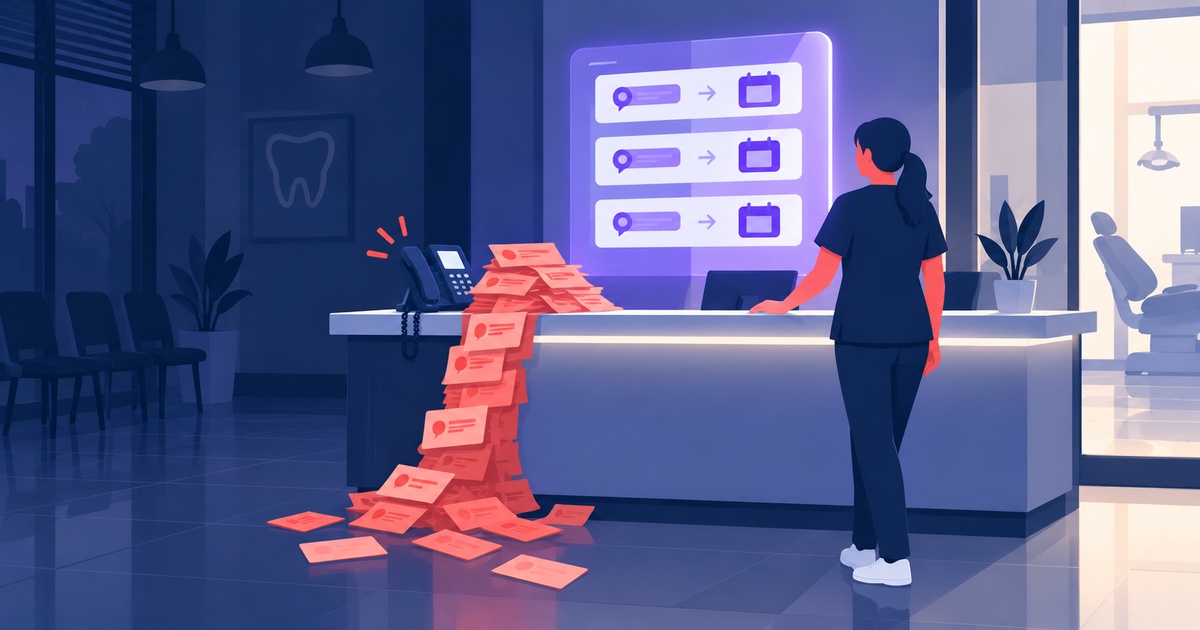
A dental answering service is an outside team or system that picks up your practice’s calls when your own front desk cannot. It takes a message, books or reschedules where it is allowed to, screens for urgency, and passes the details back to your team.
Practices usually start looking for one after a specific morning: a voicemail box with nine messages, three of them new patients who have already booked somewhere else. This guide covers what these services do, how they are priced, the four types worth comparing, and the questions that separate a good provider from an expensive one.
What is a dental answering service?
It is call coverage you rent instead of staff. Calls that your team cannot reach, whether because they are with a patient, on another line, or gone for the day, route to someone else who answers in your practice’s name.
The important distinction is between taking a message and completing the task. A service that only takes messages moves the work to tomorrow morning and adds a callback to your team’s list. A service that can actually book into your calendar removes the work. Most of the price difference between providers comes down to which of those two you are buying.
What does a dental answering service actually handle?
The realistic scope is narrower than most sales pages suggest.
| Task | Typically handled | Notes |
|---|---|---|
| Taking a message and contact details | Yes | The baseline every provider offers |
| Answering opening hours, location, parking | Yes | From a script you supply |
| Booking a new patient appointment | Sometimes | Needs calendar access, which not every provider gets |
| Rescheduling or cancelling | Sometimes | Same dependency |
| Screening for a dental emergency | Partly | Routing by urgency, not clinical judgment |
| Answering treatment or cost questions | Rarely | Usually escalated to your team |
| Insurance and benefits questions | Rarely | Too practice-specific to script |
Source: category norms across published provider documentation, reviewed October 2026. Scope varies by contract, so confirm each line with any provider you shortlist.
The row that matters most is emergency screening. An answering service can ask what happened and route the call faster. It cannot decide how urgent a problem is. That judgment stays with a clinician, and any provider implying otherwise is overselling.
How much does a dental answering service cost?
Pricing almost always follows one of four models, and the model matters more than the headline rate because it decides what a busy month does to your bill.
| Model | How it works | Watch for |
|---|---|---|
| Per minute | You are billed for connected talk time | Hold time and wrap-up time may both be billable |
| Per call | A flat rate per answered call | Wrong numbers and spam calls may still count |
| Monthly bundle | A set number of minutes or calls included | Overage rates are where bundles get expensive |
| Flat subscription | One fee regardless of volume | Usually caps what the service is allowed to do |
We are not publishing specific rates here, because they move constantly and vary by region, call volume, and how much the service is permitted to do. Ask any provider for the overage rate before the included rate. The included rate is the one they lead with, and the overage rate is the one you will actually feel in a busy month.
What types of dental answering service are there?
These are not ranked. A single-site practice with twenty after-hours calls a month has a different right answer from a six-site group with four hundred.
Two things decide it more than anything else. First, when your missed calls happen. If they cluster inside opening hours, you have a capacity problem and more coverage helps. If they cluster after close and at weekends, you have an hours problem, and paying per minute for hours nobody is awake is an expensive way to solve it. Second, whether the caller needs a person. Someone in pain at 9pm needs routing to a human. Someone asking whether you take their insurance needs an answer, not a callback tomorrow.
It is worth reading a dental answering service against an AI front desk side by side if you are weighing those last two columns specifically.
What should you ask a provider before you sign?
Questions with a right answer
- Can you write directly into our calendar, or only take messages?
- What exactly is billable: talk time, hold time, wrap-up, spam calls?
- What is the overage rate once the bundle is used?
- Will you sign a business associate agreement?
- How is patient information stored, and for how long?
- What happens to our data if we leave?
Answers that should stop a purchase
- “Our agents can tell if it is an emergency.”
- “We cannot share the overage rate until you sign.”
- “A business associate agreement is not necessary for us.”
- “We keep recordings indefinitely.”
- Any accuracy or speed figure given without a source.
The business associate agreement question is the one practices skip most often. If a service handles patient information on your behalf, that agreement is not optional paperwork, and a provider who treats it as such is telling you something about the rest of their compliance.
When is an answering service the right call?
It is a good fit when calls are genuinely your bottleneck, when callers need a person rather than an answer, and when your volume is steady enough that per-minute billing stays predictable.
It is a poor fit when most of your missed demand arrives on the website rather than the phone. A growing share of new patients never call at all. They read your page at 10pm, do not find what they need, and leave. An answering service cannot help with a visitor who never dialed, which is why some practices pair phone coverage with covering the hours your practice is closed on the website too.
How do you know whether it is working?
Track these for a month before and a month after. Most of them you already have.
| Measure | Where to find it | What good looks like |
|---|---|---|
| Missed calls | Phone system report | Falling, especially after hours |
| New patient bookings from calls | Practice management software | Rising, not just messages rising |
| Message-to-booking rate | Count how many callbacks convert | The gap between taking and completing |
| Cost per booked appointment | Service invoice divided by bookings | Stable as volume grows |
A service that increases messages but not bookings has moved work onto your team rather than off it. That is the single most common disappointment with this category, and the message-to-booking rate is the number that exposes it.
Where does cOpilot fit?
scanO cOpilot is not a phone answering service. It is an AI front desk that sits on your practice website, greets visitors around the clock, answers the questions that stall a booking, runs an in-chat oral health screening, and books the appointment in the same conversation.
It is worth considering alongside a phone service rather than instead of one, because the two cover different gaps. The answering service catches the caller. cOpilot catches the visitor who was never going to call. Practices running both usually find the phone volume drops, because the questions that generated callbacks are answered on the site.
cOpilot screens and guides. It does not diagnose. Anything clinical, urgent, or distressed should reach a person, and the handoff rule for that is something you set.
If you want the phone and website comparison in more depth, what a dental virtual receptionist covers goes through both models capability by capability.
FAQ
What is a dental answering service?
An outside team or system that answers your practice’s calls when your front desk cannot. It takes messages, answers routine questions from a script you supply, routes urgent calls, and in some cases books appointments directly into your calendar.
How much does a dental answering service cost?
Providers price per minute, per call, as a monthly bundle of included minutes, or as a flat subscription. Rates vary by region, volume, and how much the service is allowed to do, so ask for the overage rate rather than the headline rate when comparing quotes.
Can a dental answering service book appointments?
Some can, if you give them calendar access. Many only take messages. This is the single biggest difference between providers, because a message moves the work to tomorrow morning while a booking removes it.
Can an answering service handle a dental emergency?
It can ask what happened and route the call faster, which is useful. It cannot judge clinical urgency, and no provider should claim it can. That decision belongs to a clinician.
Do I need a business associate agreement with an answering service?
If the service handles patient information on your behalf, yes. A provider who tells you it is unnecessary is worth questioning closely on the rest of their data handling.
Is an answering service or an AI front desk better for a dental practice?
They solve different problems. An answering service covers callers who need a person. An AI front desk covers website visitors who want an answer and a booking without calling at all. Many practices run both, and the phone volume usually falls once the website answers for itself.